
UAE corporate tax registration: 5 mistakes to avoid

While the UAE is still a low-tax place to run a business, many UAE founders might assume low tax means low admin.
That’s where the expensive mistakes start. Once you're selling, invoicing, or renewing a trade license, tax compliance becomes part of the job – even if you don't owe tax yet.
It's tempting to treat taxes as one big task you deal with at the end of the year, but the truth is that accounting lives in the world of business deadlines. If you miss one, you could be looking at late registration penalties, cleanup work, or VAT you'd potentially have to pay from your own pocket because you didn't collect it from customers.
This guide answers the biggest UAE corporate tax questions first, then walks you through the mistakes that can cost founders the most.
In this article:
- Who needs to pay corporate tax in the UAE?
- What’s the UAE corporate tax rate in 2026?
- VAT and corporate tax: Differences and deadlines
- 5 common tax mistakes UAE business owners make
- Your UAE tax compliance checklist
- Why UAE businesses use Ziina to keep payment records cleaner
Looking for a cleaner way to collect and track business payments? With Ziina, you can accept payments through links, invoices, QR codes, Tap to Pay, and online checkout, then review and export your transaction data from one account.
Who needs to pay corporate tax in the UAE?
The short answer: If you run a business in the UAE, tax obligations will likely apply to you in some way and therefore need to be on your radar from day one.
The long answer depends on how and where your business is registered:
| Business setup | Corporate tax treatment | VAT treatment |
|---|---|---|
Mainland business (licensed by Emirates) | Standard corporate tax rules apply. Businesses must still register for corporate tax, even if they don't owe any tax. | VAT rules apply if you meet the VAT registration threshold |
Free zone business (licensed by a designated business district within the UAE) | Businesses that qualify as a Qualifying Free Zone Person (QFZP) may be eligible for 0% corporate tax on qualifying income. Other income may be subject to the standard corporate tax rules. | VAT rules apply if you meet the VAT registration threshold |
Sole proprietors | Some sole proprietors may be exempt from corporate tax obligations, depending on their legal structure and annual revenue. | VAT rules apply if you meet the VAT registration threshold |
Is your free zone business really exempt from corporate tax?
You might assume that registering your business in a UAE free zone automatically means you won't pay corporate tax. In reality, it's more complicated than that.
First, it helps to understand the difference between a mainland business and a free zone business:
- Mainland businesses are licensed by an emirate's licensing authority and can generally trade throughout the UAE, subject to their licensed activities.
- Free zone businesses are licensed by a specific free zone authority. They operate under that free zone's regulations and may face additional rules or approvals depending on where they trade and the type of business they carry out.
Mainland businesses generally fall under the UAE's standard corporate tax rules.
Free zone businesses, however, may qualify for a 0% corporate tax rate on qualifying income – but only if they meet the requirements to be treated as a Qualifying Free Zone Person (QFZP).
And that depends on a multitude of factors, including:
- The type of business activity you carry out
- Who your customers are
- Where your income is generated
- If your business has sufficient economic substance in the free zone, such as offices and employees
Where it can get complicated: An example
Imagine a hair salon that's based in a free zone. It operates from premises there, employs its staff there, and customers visit the salon in the free zone. Assuming it meets the other QFZP requirements, that income may qualify for the 0% corporate tax rate.
But if the same salon begins to send staff to complete appointments outside the free zone itself, some of that income may no longer qualify for the free zone tax treatment and could instead be taxed under the standard corporate tax rules.
In other words, registering in a free zone doesn't guarantee every dirham is tax-free. It all depends on what you do, who you sell to, where the work happens, and whether you have enough real presence in the free zone.
Does being a sole proprietor change your tax obligations?
Some sole proprietors may qualify for an exemption from corporate tax in the UAE.
If you're a freelancer or an entrepreneur, it's easy to assume you're automatically treated as a sole proprietor for tax purposes. But that's not always the case.
Whether you're eligible for the sole proprietor corporate tax exemption depends on both your legal business structure and your annual revenue. Typically, you should:
- Be legally registered as a sole proprietorship (not LLC, FZCO, SPC LLC, or another legal entity)
- Earn below an annual turnover threshold of AED 1 million
Here’s where things can get quite nuanced: some businesses choose to change from a sole proprietorship to an LLC as they grow. This can provide benefits such as separating your personal and business finances, and it may also change how your income and business profits are treated for UAE corporate tax purposes. For example, LLC owners can generally pay themselves a salary, which is treated separately from the company's taxable profits, provided it meets the relevant tax requirements.
Note: Any salary paid to a business owner should be properly documented, reflect the work performed, and be in line with market rates. If you're considering changing your business structure, it's worth speaking to a qualified tax adviser to understand the implications for your specific circumstances.
What's the UAE corporate tax rate in 2026?
| Taxable income band | Rate | What that means |
|---|---|---|
Up to AED 375,000 | 0% | No corporate tax on this part of your taxable income |
Above AED 375,000 | 9% | Corporate tax applies only to the amount above AED 375,000 |
This information was last sourced in July 2026. For further information, check the relevant sources or seek professional guidance.
Say your taxable income is AED 500,000. Here's how that calculation would likely work out:
Example calculation
| Taxable income | Amount | Rate | Corporate tax |
|---|---|---|---|
First AED 375,000 | AED 375,000 | 0% | AED 0 |
Taxable income above AED 375,000 | AED 125,000 | 9% | AED 11,250 |
Total corporate tax due | AED 11,250 |
Disclaimer: This example is for illustrative purposes only. It does not constitute tax advice and may not reflect your business's actual tax position. For further guidance, consult a tax advisor.
The final number can change based on various factors, such as if your business qualifies for Small Business Relief, has eligible tax losses, receives exempt income, and more.
VAT and corporate tax: Differences and deadlines
VAT and corporate tax are the two tax categories UAE founders need to understand the most.
VAT has been part of the system since 2018. Corporate tax came later – which is why many newer founders are still getting familiar with how it applies.
VAT is an indirect tax charged on certain taxable supplies and imports. If your business is VAT-registered, it means you must collect VAT from your customers, file VAT returns, and pay any VAT due to the FTA.
Corporate tax is a direct tax on your net profit, which is based on your taxable income as we covered above.
Deadlines to keep in mind
VAT and corporate tax each come with their own registration rules, filing requirements, and payment timelines.
The big thing to watch is timing.
- For VAT registration in the UAE: timing depends on your taxable supplies and imports over a rolling 12-month period. Once they exceed AED 375,000, you typically need to register within 30 days.
- For corporate tax registration in the UAE: your registration deadline depends on your trade license timeline. Many businesses need to register within three months of receiving their trade license, but the rules can change depending on when the business was set up, whether it’s registered outside the UAE, and whether it earns UAE-linked income.
Note: Even if your business doesn't ultimately owe corporate tax, you might still need to register and file a corporate tax return. If you don’t register for UAE corporate tax in time for your deadline, you could be facing a penalty of AED 10,000.
Once you’re registered, you need to look out for your filing and payment deadline – but the good news is that date is the same. Generally, you should file and pay within nine months from the end of your tax period.
To illustrate: if your tax period ends on 31 December 2026, your corporate tax return and payment would usually be due by 30 September 2027.
Note: If you import products, materials, or equipment into the UAE, customs duties can also apply. These are separate from VAT and corporate tax, so check the customs rules for the goods you’re bringing into the country.
What to prepare before you file
Before you file, you’ll need your core records ready: financial statements, taxable income calculation, and any adjustments that affect the final number. Depending on your setup, you might also need details on exempt income, tax losses, related-party transactions, free zone income, or any reliefs you’re claiming.
Corporate tax returns are usually filed through the EmaraTax portal. Before submitting, check the legal name, Corporate Tax Registration Number, and tax period carefully, especially if you manage more than one business.
5 common tax mistakes UAE business owners make
- 1.Missing corporate tax or VAT registration deadlines. As soon as you receive your trade licence, check your corporate tax registration deadline. Separately, track your taxable supplies and imports each month so you know when you're approaching the AED 375,000 VAT registration threshold.
- 2.Mixing personal and business expenses. If supplier invoices are under your personal name, it can be harder to prove that those expenses are tied to your business at tax time. Use your company details on business purchases, and ask suppliers to reissue invoices if the name, TRN, address, or service description is wrong.
- 3.Paying yourself without proper documentation. Owner payments need to be handled carefully, especially as your business grows. If you’re paying yourself a salary through a company structure, keep the right contracts and salary support in place so the amount is clearly tied to your role and market rates.
- 4.Waiting until deadline week to update your records. Leaving receipts, invoices, and payment records until the last minute makes filing harder than it needs to be. Keeping records current throughout the year gives your accountant less cleanup work and gives you more time to track down any missing documents.
- 5.Assuming your accountant will handle everything. A good accountant is invaluable, but they're only as effective as the information you provide them with. You're still responsible for understanding the basics of your tax obligations and meeting deadlines. Learn the fundamentals of how corporate tax and VAT apply to your business and ask questions early if you're unsure.
Your UAE tax compliance checklist
Avoiding these common tax mistakes comes down to building good habits that make your life easier at tax time. A basic system for deadlines, documents, and payment records is a good place to start:
Deadlines
- Register for corporate tax on time
- Track VAT taxable supplies monthly, especially as revenue grows
- Set reminders before filing deadlines
Documents
- Keep business and personal expenses separate
- Make sure supplier invoices use the company name exactly as shown on your trade license
- Check that invoices include the right details, like TRN where relevant, address, and a clear service description
- Ask suppliers to reissue invoices early if the company name, TRN, address, or service description is wrong
Payment records
- Keep payment records and invoice records together
- Export transaction data regularly
Support
- Speak to an advisor before a deadline becomes urgent
- Spend a couple of hours learning the basics, so you know what to ask your accountant
Why UAE businesses use Ziina to keep cleaner payment records
Every payment you accept creates a record your accountant will need later.
Ziina helps keep your business payments easy to collect, track, and export from the first dirham.
As a payment app specifically built for UAE entrepreneurs and businesses, our goal is to help you accept payments across multiple channels in one place – and, as a result, keep cleaner records more easily.
Here’s what you can do with Ziina:
Accept payments across various channels without extra admin
Once you start selling, payments can come from multiple places: a WhatsApp conversation, a digital invoice, a QR code at an event, your website checkout, you name it.
Ziina brings these payment methods into one mobile-first setup:
- Payment links: Share branded payment links through social media, SMS, email, or other customer conversations.
- Digital invoices: Send customized payment requests and let customers pay directly by card, Apple Pay, or Google Pay.
- QR codes: Let customers scan and pay at a counter, pop-up, event, delivery point, or service location.
- Tap to Pay: Turn a compatible phone into a contactless payment terminal for in-person card payments.
- Online checkout: Add Ziina checkout to your website so customers can pay online.
That means fewer dashboards to check, fewer screenshots to chase, and fewer manual notes about who paid where. This can make a large difference, especially if customers don’t always pay right away.
The Expat Group, a Dubai-based HVAC, electrical, and plumbing business, was dealing with exactly that problem. Before Ziina, some customers took days or weeks to pay.
The team needed a faster way to collect payments without adding more manual admin, so they started sending Ziina Payment Links through WhatsApp while the customer conversation was still active.
Today, 75% of customers who receive a Ziina Payment Link pay instantly, reducing delayed payments by 75% overall.
“Before Ziina, it was difficult for us to gauge how much our customers appreciated a convenient way to pay. We’d get requests for payment links all the time. It was almost like our customers were saying, ‘Help us pay you faster.’”
How The Expat Group reduced payment delays with Ziina's fast cash outs

Make tax time easier with cleaner payment records
Once payments arrive in your account, you need a clean way to move your funds where they need to go and keep track of those records.
Payments collected through Ziina flow directly into your Ziina Wallet, which keeps your payment activity together and easier to manage.
From there, you can cash out to a linked UAE bank account when you need to. Cashouts typically take 1–2 days for amounts below AED 25,000 and 3–5 days for amounts above AED 25,000, subject to bank processing times and Ziina’s terms.
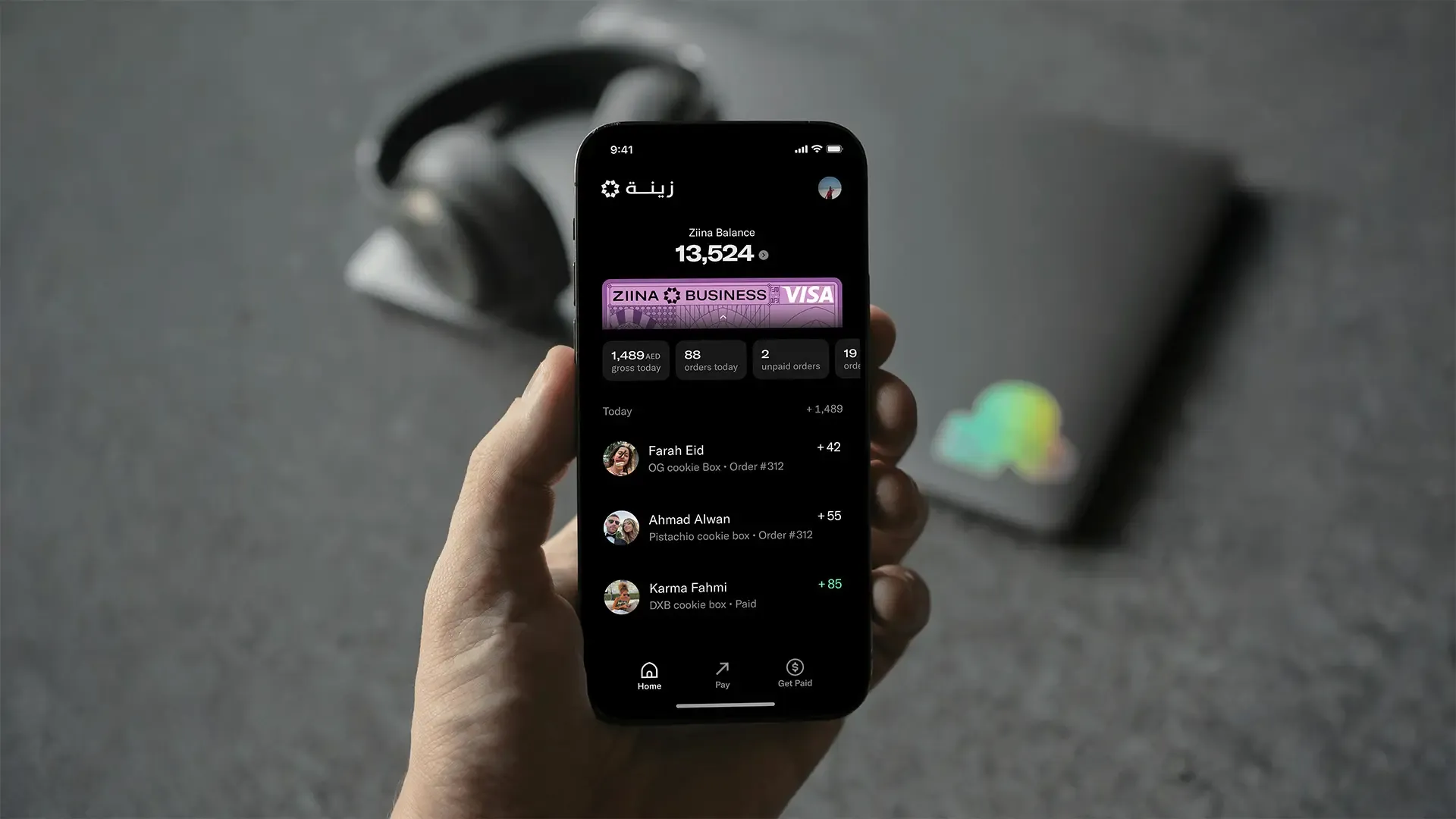
You can also spend directly from your wallet with the Visa-powered Ziina Card wherever contactless payments are accepted.
Ziina has no setup fees or minimum balance requirements, so you only pay for the transactions you process. You can easily review transaction activity in your Ziina account, so it’s easier to see what came in, when it was paid, which payment method the customer used, and any related fees.
And when it’s time to share records, you can export your transaction data as a CSV. Ziina may also be able to integrate with accounting platforms like Skrooge, which helps connect your real-time payment activity directly with your tax preparation.
Get local support and secure payments from day one
Once payments become part of your daily operations, you need a setup that’s secure, easy to manage, and built for how UAE businesses actually work.
Ziina is homegrown in the UAE and offers dedicated support in English and Arabic. Our team knows the local market and always aims to quickly answer any questions.
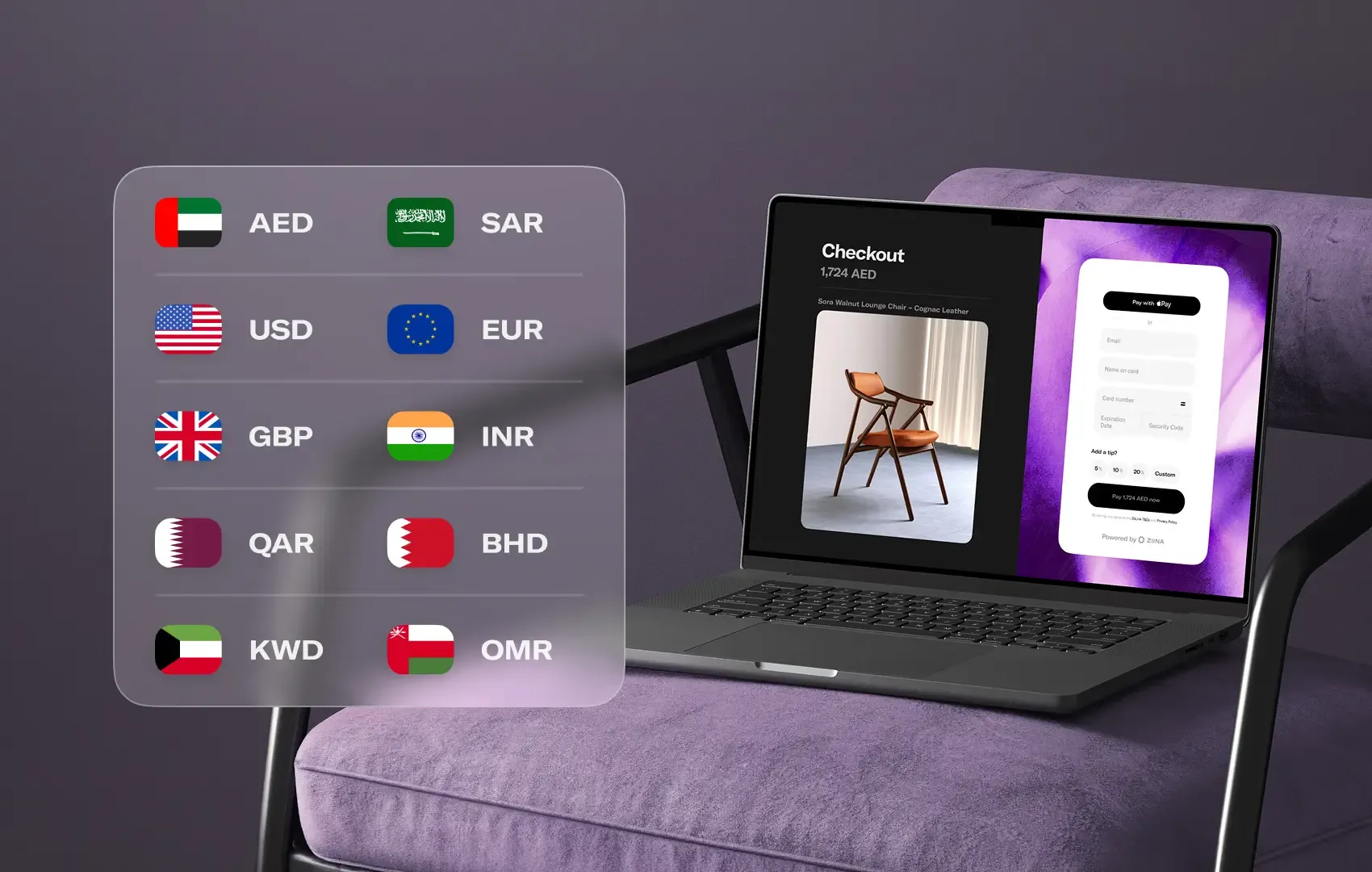
Ziina also enables you to collect multi-currency payments in up to 10 currencies, including SAR, USD, EUR, GBP, and QAR. For app-generated payment links, customers can choose their preferred currency, while settlements to your Ziina Wallet are processed in AED at Visa’s exchange rate (subject to Ziina’s latest terms and conditions).
Ziina uses PCI-DSS certified technology for payment card information, along with available security features like encryption, biometrics, and PIN codes.
Get ready for UAE business tax deadlines with Ziina
UAE business tax is easier to manage when your records, payment activity, and deadlines are organized from the start.
That means knowing which taxes apply, tracking your VAT threshold, keeping invoices under the right name, and making sure your payment records are clean enough to hand off when filing time comes around.
Ziina helps keep your payments organized and manageable. You can accept payments across multiple channels, review your transaction history in one app, easily cash out from your Ziina Wallet, and export payment data when it's time to share records with your accountant.
Disclaimer: The information in this article is general and for informational purposes only. Business setup requirements, government fees, tax treatment, and licensing rules may vary depending on the jurisdiction, activity, and individual circumstances, and may change over time. Businesses should confirm current requirements with the relevant authority and obtain professional legal, tax or business-formation advice where appropriate. Ziina products and services remain subject to eligibility, successful verification, applicable limits, and Ziina’s terms and conditions. Customers are responsible for ensuring they hold any trade license, permit, tax registration, or other approval required for their business activities. Fees, limits, payout timelines, and product features may vary and are subject to change. Please refer to Ziina’s latest terms and pricing for full details. This article was published in September 2026.